Automotive CRM for Canadian Dealers: The Speed-to-Lead Playbook I Built on the Floor
Written by Denis Mahoney, Co-Founder of Frayze. Before Frayze, I built and ran the lead engine for a six-rooftop auto group. This is what I learned about automotive CRM the hard way — on the floor, not in a feature sheet.
It is 6:14 on a Saturday. A buyer on your website fills out a finance application on a used Silverado. She is ready. She has the down payment, she has been pre-approved somewhere else already, and she wants to know one thing: can she drive it home today.
Your CRM captured that lead perfectly. It sits in a queue, tagged and timestamped, waiting for Monday. By Monday she has bought the truck down the road, because a salesperson there texted her back in ninety seconds.
That is the real story of automotive CRM, and almost no one tells it honestly. The software did its job. You still lost the deal. After a decade of running dealership lead systems — including 250,000+ monthly automations across a six-rooftop group — I can tell you the CRM is rarely the thing that's broken. Your response chain is.
This is the guide I wish someone had handed me in year one. It is written for Canadian dealers — independents and small groups — who are tired of buying tools and still watching deals leak out the bottom.
What an automotive CRM actually is (and the lie in the category)
An automotive CRM (customer relationship management system) is the software that stores every lead, customer, and deal your dealership touches, and organizes the follow-up around them. In a dealership it usually sits between your website, your inventory feed, your phone system, and your DMS, and it is supposed to make sure no opportunity falls through a crack.
That is the textbook definition, and every vendor blog on the internet will give it to you. Here is the part they leave out: a CRM is a filing cabinet, not a salesperson. It records what happened. It does not, by default, make anything happen. A lead can sit correctly tagged in a perfectly configured dealership CRM for eighteen hours and die there, and the CRM will report that everything worked exactly as designed.
The category sells you a database and lets you assume you bought a follow-up system. Those are two different purchases. The gap between them is where your margin lives.
The one number that decides most of your deals: speed to lead
If you only fix one thing this year, fix your response time. The research here is old, boring, and brutally consistent:
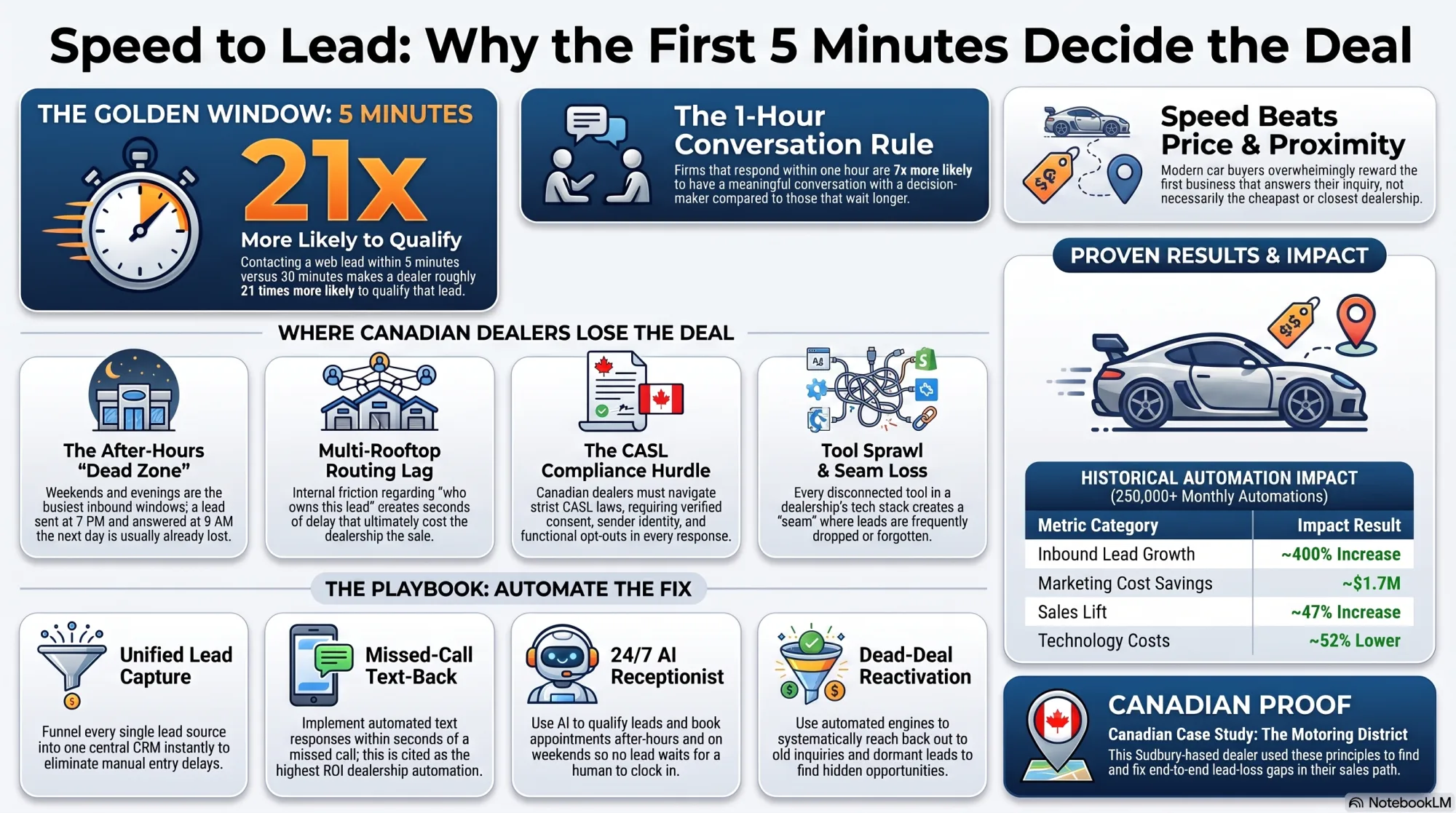
- The widely cited Lead Response Management study (Oldroyd, Kellogg/MIT) found that contacting a web lead within five minutes versus thirty makes you roughly 21x more likely to qualify that lead. The odds fall off a cliff almost immediately.
- Harvard Business Review's research on the "short life of online sales leads" found that firms that responded within an hour were about 7x more likely to have a meaningful conversation with a decision-maker than those who waited even sixty-one minutes longer.
- Across the sales world, the pattern that keeps repeating: buyers overwhelmingly reward the first business that answers. Not the cheapest. Not the closest. The first.
I want to be straight with you about these numbers, because our industry abuses them. You will see blogs quote a "391% conversion lift in the first minute" with no source and no context. Ignore that stuff. The honest version is simpler and still decisive: the faster you respond, the more you sell, and the drop-off after the first few minutes is steep. You don't need a cherry-picked stat to act on that. You need a queue that doesn't sleep.
Where Canadian dealers actually lose the deal
Most CRM advice online is written for a generic US enterprise dealership with a full BDC and a night shift. That is not the dealer I build for. Here is where independents and small groups in Canada actually bleed leads — the stuff the feature sheets never mention:
After-hours and weekends are your biggest leak
Your busiest inbound window is often the exact window nobody is at a desk. Evenings, Sundays, holidays. A lead that lands at 7pm and gets a first human touch at 9am the next day is, statistically, already gone. If your after-hours plan is "voicemail," you are donating those buyers to whoever automated their reply.
Multi-rooftop routing chaos
The moment you have more than one location, "who owns this lead" becomes a real question, and every second spent answering it is a second the buyer spends elsewhere. I have watched groups lose more deals to internal routing lag than to price. A lead for the Thunder Bay store landing in a general inbox and getting forwarded twice is a lead you've already half-lost.
Consent and compliance are not optional here
Canada is not the US on this. Under CASL, you cannot just start blasting SMS and email at anyone who sniffs your inventory. Consent has to be real, opt-out has to work, and your automation has to respect it. The good news: a well-built system makes compliance automatic instead of a liability. The bad news: a lot of imported "growth hacks" are quietly illegal up here.
The DMS and tool sprawl tax
Independent dealers often run a website tool, a separate lead form, a texting app, a reviews app, a booking tool, and a CRM that talks to none of them cleanly. Every seam between those tools is a place a lead gets dropped or double-handled. The cost isn't the subscriptions. It's the deals lost in the gaps.
What 250,000 automations a month actually taught me
Before Frayze, I was hired as the systems and growth lead at Need A Car — the used-vehicle group under Toronto Auto Group, running across the GTA and up into Northern Ontario. Six rooftops. My job was to stop the bleeding and build the machine.
The results from that work are real, and I'll state them plainly because they're the reason I trust what I now build: over that period we drove roughly 400% growth in inbound leads, cut about $1.7M in marketing costs by killing what didn't work, lifted sales by ~47%, and reduced technology costs by around 52% by consolidating a mess of tools into one connected system. At peak we were running 250,000+ automations a month.
I want to be careful and honest about what those numbers are. That was my operator track record before Frayze existed — it is the experience Frayze is built on, not a client testimonial. And here is the part the vendor blogs will never admit: none of it happened in the first month.
The uncomfortable truth about automotive CRM is that the technology is the easy 20%. The hard 80% is adoption — getting a floor full of salespeople who've been burned by three previous "systems" to actually trust the queue, work the tasks, and let the automation do the boring parts. The dealers who win aren't the ones who bought the best CRM. They're the ones who committed to changing how the floor works. Anyone who tells you a tool alone fixes this has never stood on a dealership floor at close on a Saturday.
The playbook: what actually fixes lead loss
This is the system I rebuild for every dealer now. It is not a product pitch — you can assemble most of it yourself if you have the time and the patience. Here's the order that matters:
1. Instant lead capture from every source into one place
Website forms, Marketplace, AutoTrader, phone, walk-in, chat — all of it lands in one CRM the instant it happens, with the source tagged. If a lead has to be manually copied from one tool to another, it will eventually be forgotten. One inbox, no exceptions.
2. Missed-call text-back (the single highest-ROI automation in a dealership)
Every missed call triggers an automatic text within seconds: "Hey, it's [Dealership] — sorry we missed you, were you calling about a vehicle? Happy to help right here." This one automation recovers deals you didn't even know you were losing, because a missed call at a dealership is almost never someone who'll leave a voicemail. They just call the next dealer. A text back keeps the conversation on your lot.
3. An after-hours AI receptionist that never sleeps
When the floor is closed, an AI agent answers the text, qualifies the buyer, books the appointment, and hands a warm, informed lead to your team for the morning. Not a chatbot that frustrates people — a genuinely useful first responder that protects your evenings and weekends. This is the difference between capturing the 7pm buyer and reading about her purchase somewhere else.
4. Speed-routed follow-up with real accountability
Leads route to the right person at the right rooftop instantly, with an escalation if they're not worked in minutes. The system doesn't just hope the salesperson follows up — it verifies it and nudges when they don't. Speed to lead only works if someone is actually accountable for the clock.
5. Dead-deal reactivation
Every dealership is sitting on a goldmine of "lost" leads — people who inquired, didn't buy, and got forgotten. A structured, compliant reactivation sequence quietly works that list in the background. The cheapest deal you'll ever make is one you already paid to generate a year ago.
6. A reviews engine that runs itself
Every closed deal automatically, and compliantly, asks for a review at the right moment. Reputation isn't vanity — for a dealer it's the top of the funnel. More real reviews means more inbound, which feeds everything above.
Proof it works in Canada — not just in my old job
It's fair to ask: that Need A Car story is great, but that was then. Are you doing it now, up here, for real dealers?
Yes. The Motoring District in Sudbury is a signed Frayze dealer running on exactly this system. When we came in, we did what I do everywhere first: we traced a real lead all the way through their setup to see where it actually went. We found a lead-loss gap — leads that looked captured but weren't reliably landing where a salesperson would see them in time. We fixed it, and then we verified the whole path end to end: submit a lead, watch it land in the CRM, in the right pipeline, in front of the right person, with the follow-up firing. Not "it should work." Proven working.
That's the standard. I won't quote you a client's revenue number I haven't confirmed and cleared to share — that's a line I don't cross, and you should be suspicious of any agency that sprays around outcome stats with no methodology behind them. What I'll promise is the mechanism: your leads get captured, get answered fast, and stop dying in the gaps. That is the thing that moves the number that matters to you.
How to choose an automotive CRM (without buying another shelf-ware tool)
If you're shopping, here's what actually separates a system that works from a logo you'll resent in six months:
- Does it respond, or just record? Ask specifically how it handles a lead at 8pm on a Sunday. If the answer is "it stores it," keep looking.
- Is it one connected system, or five apps in a trench coat? Every integration seam is a leak. Fewer tools, tighter.
- Is it built for Canadian compliance? CASL, consent, opt-out — baked in, not bolted on.
- Is it managed, or dumped on you? The graveyard of dealership CRMs is full of powerful tools nobody had time to configure. For most independents, "managed" beats "flexible."
- Will they prove it end to end before go-live? If nobody will sit with you and watch a test lead flow all the way through, you're buying a promise, not a system.
That last one is the tell. Anyone can sell you software. The people worth hiring will prove the deal path works before they ask you to trust it.
Frequently asked questions
What is the best CRM for an independent car dealer?
The "best" one is the one your floor will actually use and that answers leads instantly, including after hours. For most independent dealers that means a managed, all-in-one system over a powerful-but-unmanaged enterprise tool you'll never fully configure. Prioritize response speed and adoption over feature count.
How fast should a dealership respond to a lead?
Within five minutes, ideally instantly. Research on online leads shows the odds of qualifying a lead drop sharply after the first five minutes, and buyers strongly favour the first dealer who responds. Automation (missed-call text-back and an after-hours AI receptionist) is how you hit that window without staffing a 24/7 desk.
What is "speed to lead" and why does it matter for car dealers?
Speed to lead is how fast you make first contact after someone inquires. For dealers it's decisive because vehicle buyers are often shopping several dealers at once and moving quickly. The first useful response usually wins the conversation, and the conversation is what wins the deal.
How do I stop losing after-hours and weekend leads?
Automate the first response. A missed-call text-back and an AI receptionist that qualifies and books appointments after hours means every evening and Sunday lead gets an immediate, useful reply and a warm hand-off to your team in the morning — instead of a voicemail nobody hears until the buyer has moved on.
Is automated dealer texting legal in Canada?
Automated texting is legal when it complies with CASL: you need proper consent, clear sender identity, and a working opt-out. The problem isn't automation — it's automation built without compliance in mind. A properly built Canadian system makes consent and opt-out automatic. (This is general information, not legal advice.)
The bottom line
Your automotive CRM is probably fine. Your response chain is where the deals are dying — after hours, in the routing lag, in the gaps between your tools. I know this because I spent years fixing exactly that across six rooftops before I ever started Frayze, and I've spent the time since proving the same system works for Canadian dealers now.
We're not selling you another shelf. We build the catch-the-lead system, we manage it, and we prove the deal path works before you trust it. Built in Ontario, tested on real dealership floors, ready for yours.
If you want to see exactly where your dealership is leaking leads right now, we'll trace one live and show you. That's the whole offer — no theatre, no invented stats. Just the truth about your response chain and a plan to fix it.
Stop losing jobs to slow follow-up.
We build the system that texts back missed calls, follows up automatically, and books the job — so Thunder Bay business owners stay focused on the work, not the phone.